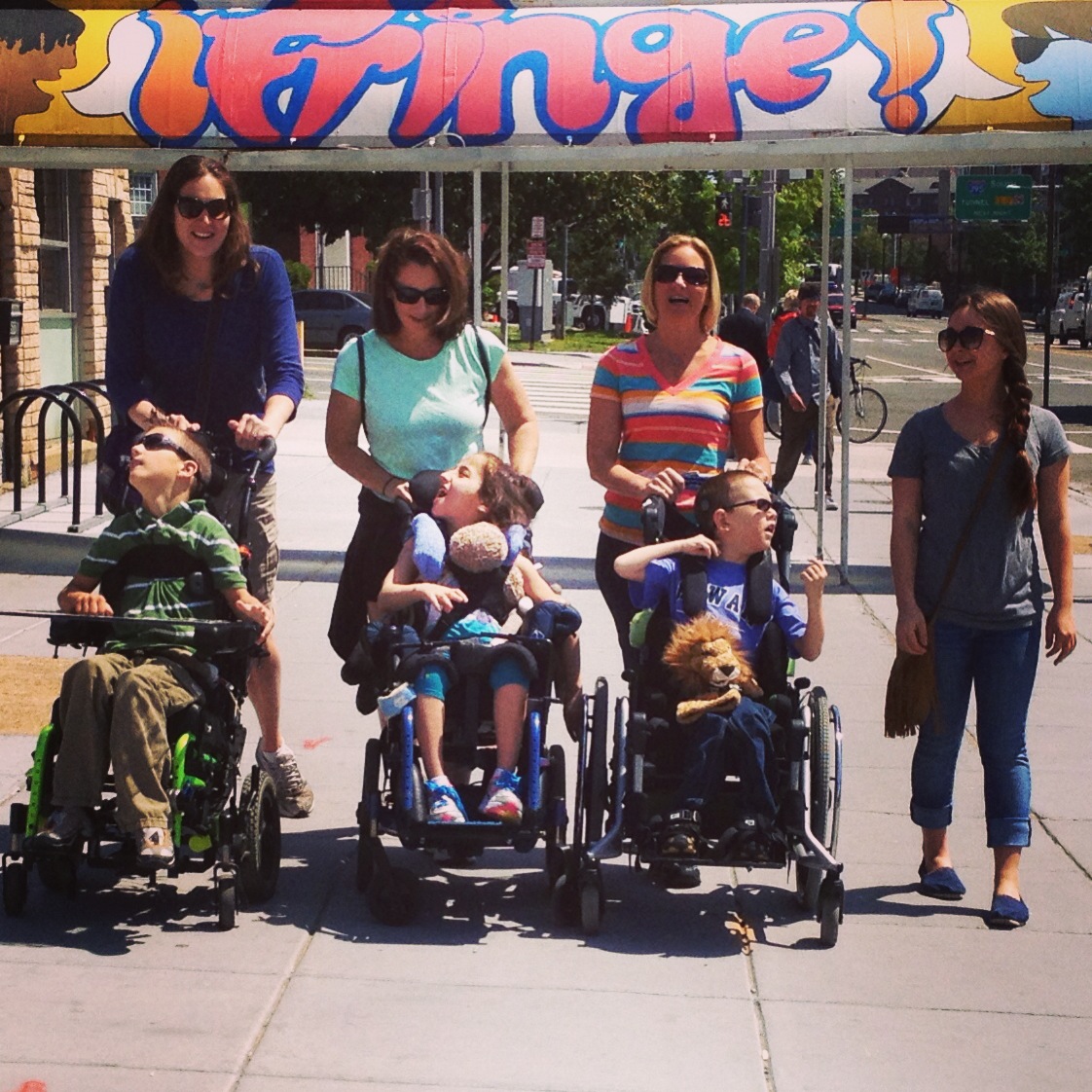
May 2nd 5 moms, 3 of which brought their kids with KI, (equipped with the wheelchairs that KI brought into their lives…and more than a few other pieces of medical equipment) to DC.
We were invited quests at the pediatric Academic Society’s annual meeting, particularly the bilirubin club, the global prevent kernicterus network, and the kernicterus symposium.
For those of you that aren’t familiar with us, PICK is a small grass-roots non-profit that has reorganized and reemerged from several dormant years. We have 2 missions that fuel one another:
Prevent
Cure
In a nutshell, it’s this:
- Jaundice can be harmful to newborns
- Proactive care, testing, evaluation, screening, and treatment are NEEDED
- These steps can PREVENT KI for happening
- We advocate education and compliance to standards that will stop KI before it starts.
- For those who already live with the devastating consequences, be they severe (appearing much like spastic quadriplegia, coupled with hearing loss, inability to eat, digest food properly, speak, and sleep) or milder (appearing more like behavioral issues, hyperactivity and frustration) there is a great need for research leading to EFFECTIVE treatments…treatments that will pave the way toward a cure.
So, back to DC, our mission there, although barely articulated behind the flurry of arrangements for childcare, spouses, nursing care, lodging, fundraising (we each paid our way almost entirely…but don’t feel too sorry for us, WE BELIEVE in this and are willing to invest in it). So our mission:
- Let the medical community, particularly those who are invested in bilirubin research, phototherapy, testing, neonatology, neurology and pediatrics, remember what they are about
- Get the word out that our membership CONTINUES to grow (this is NOT a good thing, and yet it can be used for good in that it can help us pursue better treatments and get the word out)
- Network with others invested in seeing KI stopped.
- Get the word out to connect other KI families across the globe (for more effective research and treatment)
- Let our kids work on something bigger than themselves…making lemonade of the lemons in their life…not suffering silently, but using their collective voice to impact change
At times, between diaper changes, tube feedings, charging medical devices, concerns about brewing troubles in their complex bodies, taking time to let the kids stretch outside of their wheelchairs etc…it felt like we just didn’t have enough to give. Indeed our actions had to be arranged around our kids needs. They were the stars of the show,after-all, and their needs had to be met.

this was all of the equipment that we brought for my son
And they were AMAZING. What highly intelligent kids sitting in bodies that would not cooperate at 7,9, and 11 years old would sit through hours of lecture on high level science behind phototherapy? These kids!
At one point I had to wipe my boys tears from his eyes as he saw a slide of a severely jaundiced and critical baby. He can barely utter a word, and yet, he spoke volumes, and the whole room saw it. He knows what happened to him, and he carries a tremendous amount of compassion for other children at risk. He’s on the team!
There was more than 1 teary eyed physician that offered thanks for our organization and for our kids and the inspiration they offered. They shined. Their intelligence and humor shined. They made us laugh constantly, and many docs offered thanks to us forreminding them what they are about in the fight to stop KI.
Our hearts broke to hear more about the extent of the global burden of jaundice, and the cataclysmic damage left in it’s wake. But we didn’t just talk about the problem, we heard from the field, what people are DOING about it…products being developed to make testing in the field affordable and portable with minimal battery power, safer means of heliotherapy for babes that don’t require the NICU, and phototherapy options for between $200-600 that last 8 years and are built to withstand power surges and shortages. WE WERE INSPIRED. There is a problem, and there are people out there with their hearts and minds invested in the battle to see it stopped to stopKI!!!
We won’t lie. Speaking about KI for 16 hours a day for 5 days, while caring for our kids – NOT EASY. We each fought back tears of our own at different times. Living in the reality and discussing a tragedy beyond human comprehension – it takes it’s toll.
Doing something –
Acting –
Being the one that cries out, that exposes the need for action –
Seeing the powerful voice that our children have…the voice that is so much stonger than words uttered –
…it’s medicine for the soul!
Networking.
- We made dozens of contacts and are in the process of developing an educational program for professionals, that will be viewed at several university hospitals.
- Some of our growing group in Brazil will be able to meet this week with a non-profit that is working to give Brazil access to more affordable and effective phototherapy.
- Our kids got to meet many heros that have fought to prevent their condition. They inspired one another, and the docs that work hard to stop KI.
- We received over $7,000 in donations as a direct result of our work there. (These expenses will be used to support research and reimburse some of the board’s travel expenses.)
- We were able to distribute over 500 of our brochures.
- Numerous board meetings and brainstorming took place (something that is often a challenge given our spread over 3 time zones and busy schedules.)
And then there are the things that don’t fall into bullet points as easily:
For the first time that I know of, in over 8 years, 3 kids with KI got a chance to spend five days together. It gave us a unique time to reflect, as mothers, on the similarities and differences our children share. This information might prove very useful in steering research. And speaking of research – the leading researchers of KI and hyperbilirubinemia were THERE and they were taking it all in too! In fact, the fabulous neurologist and world-renown researcher Dr. Steven Shapiro spent a large amount of time with our kids. There was some fabulous conversation about science, some great connections on research to benefit our kids, and educationalventures to help encourage better handling of newborn jaundice, and some fun too!
We very much look forward to the day when our organization will grow to a size that can accommodate a FAMILY CONFERENCE. Bringing the researchers and families TOGETHER – there will be more benefits there than I can articulate.
And humor!!! Lexi, not only has an IQ of 160, but she also has a wicked sense of humor. Lexi does not have the hearing loss that the boys have, and is able to speak several words rather reliably. The boys understood every bit of what Lexi was getting at. The ability to speak does not negate the ability to understand. We were able to ask questions and give options and get huge smiles and laughter in response…and the laughter of Lexi and Blue and Zach is a tangible piece of pure joy!!!
So, between laughter and tears and long days, and new connections, YES, we conquered!

Support


 pic-K
pic-K 